
William Wallace, Scottish patriot, hanged, disemboweled, beheaded, and quartered in London
Sir William Wallace (c. 1276 - August 23, 1305) was a Scottish knight who led his countrymen in resistance to English domination in the reign of King Edward I, during significant periods of the Wars of Scottish Independence.
ireland
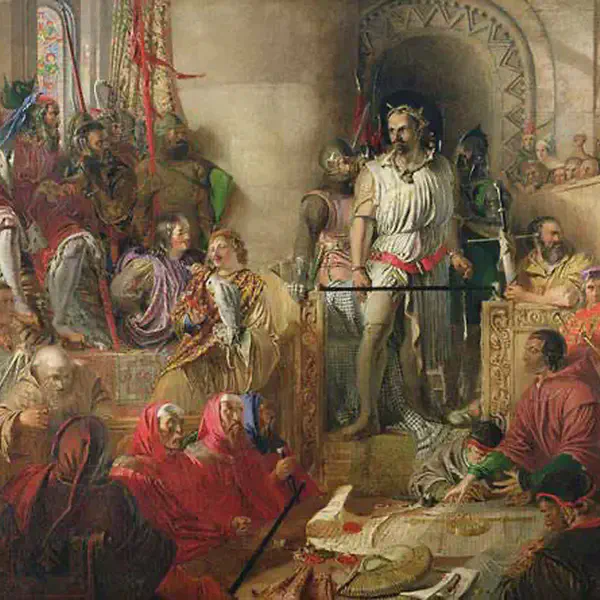
William Wallace betrayed and captured by the English.
Sir William Wallace (c. 1276 – August 23, 1305) was a Scottish patriot who led his country against the English occupation of Scotland and King Edward I of England during significant periods of the Wars of Scottish Independence.
ireland
William Wallace routs English at the Battle of Black Ironside
Sir William Wallace (c.1270 – 23 August 1305) was a Scottish knight who led a resistance to the English occupation of Scotland during significant periods of the Wars of Scottish Independence. William was the inspiration for the historical novel The Acts and Deeds of Sir William Wallace, Knight of Elderslie written by the 15th century minstrel Blind Harry. The novel is responsible for much of the legend encompassing the history of William Wallace.
ireland
Wallace and Moray Declare Scotland’s Victory to Lubeck and Hamburg
1297 – Wallace and Moray Declare Scotland’s Victory to Lubeck and Hamburg
ireland
Victory of Wallace at Stirling bridge, Scotland
On September 11, 1297, Wallace achieved victory at the Battle of Stirling Bridge. Although vastly outnumbered, the Scottish forces led by Andrew de Moray (a more prominent noble, being a first son) and with Wallace as their captain, routed the English army. The Earl of Surreys professional army of 300 cavalry and 10,000 infantry met disaster as they crossed over to the north side of the river. The narrowness of the bridge prevented many soldiers from crossing together (possibly as few as three men abreast), so while the English soldiers crossed, the Scots held back until half of them had passed and then killed the English as quickly as they could cross. English soldiers started to retreat as others pushed forward, and under the overwhelming weight, the bridge collapsed and many English soldiers drowned. Unbeknownst to the now chaotic English army, part of the Scots army had forded further up the river. With the English army divided opposite each bank of the river, the two Scot forces pressed both halves of the English army towards the river. The Scots won an overwhelming victory and hugely boosted the confidence of their army. Hugh Cressingham, Edwards treasurer in Scotland, died in the fighting. Moray died of wounds suffered on the battlefield three months after the Battle of Stirling Bridge. Upon his return from the Battle of Stirling Bridge, Robert the Bruce knighted and elected Wallace the Guardian of the Kingdom of Scotland and Leader of its armies, now Sir William Wallace.
ireland
William Wallace seizes high ground above Stirling Bridge and bars route of invading English in battle the following day.
On September 10, 1297 William Wallace seizes high ground above Stirling Bridge and bars route of invading English in the The Battle of Stirling Bridge the following day. In numbers the Scots had around 15,000 and the English possibly 60,000, but probably 50,000. De Moray, with William Wallace as his captain, and their forces had come from besieging Dundee and stood situated on the high ground of Abbey Craig, across the Forth and to the north of Stirling. The English forces sought to cross the single narrow bridge and engage the Scottish force.
ireland